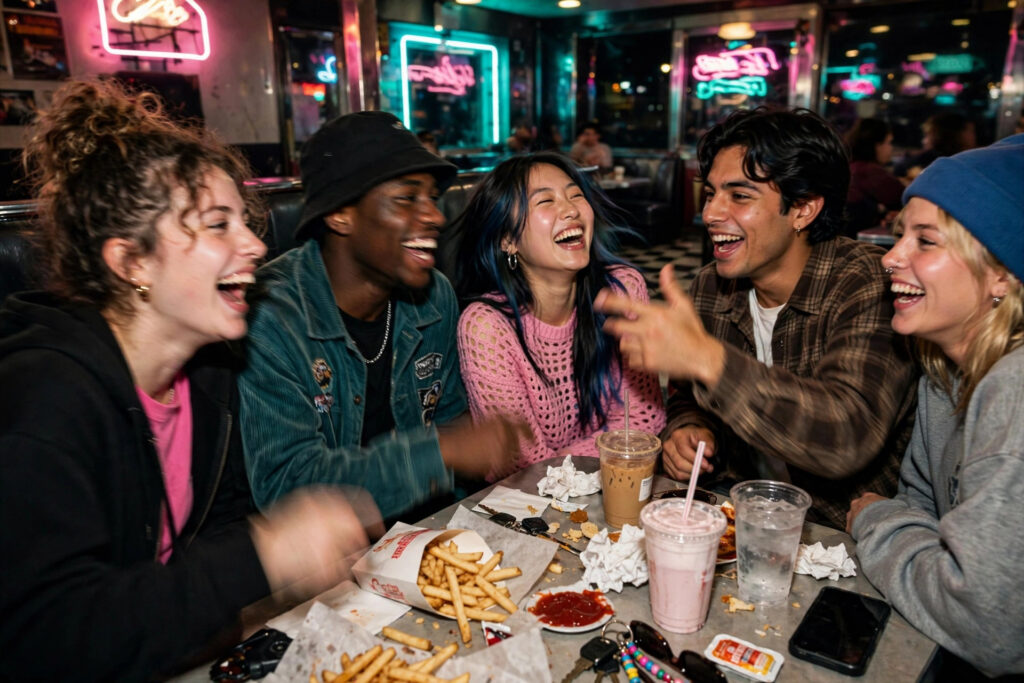
Gen Z is ditching curated Instagram feeds for photo dumps because perfection stopped being believable. AI-generated content made polished photos look fake, posting pressure made the grid exhausting, and a blurry midnight candid now reads as more honest than a staged sunset. The dump isn’t laziness — it’s a vote for real life over a highlight reel.
Open Instagram right now and look at what people are actually posting — not their grids, nobody looks at those anymore. The grids are dead air: frozen museums of 2019, all beige outfits and golden-hour rooftops, abandoned like old MySpace pages. The action moved to the carousel — ten, fifteen, twenty slides of blurry concert shots, half-eaten fries, a screenshot of a text from your mom, your friend mid-sneeze. Nobody’s trying to look good. Everybody’s trying to look real. Five years ago, that sentence would have made no sense at all.
Perfection Became a Liability
Here’s the plot twist nobody predicted: the curated feed wasn’t killed by rebellion. It was killed by robots.
In a year-end essay posted to Threads, Instagram head Adam Mosseri admitted something wild — AI-generated content has shattered the visual trust that once powered the platform. When an image can be generated in seconds, a perfectly lit photo no longer proves that anything happened. Perfection, he wrote, now sparks “suspicion.”
Read that again. The head of Instagram saying perfect photos look suspicious. The aesthetic that built the platform is now a red flag.
Mosseri also pointed out what his own data keeps confirming: most users under 25 no longer care about posting to their public grid at all. They’re sharing “unflattering candids” in private group chats and disappearing stories instead — a quiet rebellion against the whole idea of algorithm-chasing polish. If a photo is too smooth, too symmetrical, too sharp, the default assumption in 2026 is that a machine made it. Perfection used to say “I have taste.” Now it says “I might not exist.” A blurry photo of your friends laughing too hard at 1 a.m. is one of the few things AI still can’t fake convincingly — and everyone under 25 can feel the difference.
“When images can be generated in seconds, a perfectly lit photo no longer proves that anything happened. In fact, it now sparks suspicion.” — Adam Mosseri, Instagram head, in a year-end essay on Threads
The Grid Was Unpaid Labor
Before AI finished the job, the grid was already dying of exhaustion.
Think about what the curated era actually demanded. After Instagram went algorithmic in 2016, the grid stopped being a diary and became a portfolio. Then came the color-coordinated era: pick a palette, stick to it, delete anything that breaks the pattern. The 2019 VSCO-girl phase ran on film presets and scrunchies; the clean-girl aesthetic ran on slicked-back buns and matching beige sets. Every era had a dress code, a filter, and an unspoken rulebook.
Keeping up was a part-time job nobody applied for. Thirty versions of a coffee cup. A cleaned room photographed for one corner of it. Friends waiting while you posed against a wall, then cropped out of the shot. The feed looked effortless because the effort was hidden — which is, when you think about it, the most exhausting kind of effort there is.
The numbers back it up. According to Sprout Social’s 2025 social media benchmarks, single-image posts have dropped 7% since 2023 — the standalone “perfect shot” is quietly going extinct. Meanwhile, Instagram expanded carousels from 10 to 20 slides in 2024, basically building the dump a bigger house. The platform saw where this was going and renovated for it.
The photo dump — a format creators like Emma Chamberlain were already mainstreaming years ago — won because it flipped the economics of posting. One perfect photo costs an afternoon. Twenty random ones cost nothing. Open the camera roll, pick the blurry ones with good energy, go back to your life.
BeReal Called It First
Credit where it’s due: a French app with no filters saw this coming in 2020.
BeReal’s pitch was almost insultingly simple. Once a day, at a random time, your phone buzzes. Two minutes to post — front and back camera at once, no filters, no editing, no do-overs that don’t get flagged. Just: what are you actually doing right now? Sitting in a lecture? Eating cereal over the sink? Great. Post it.
It exploded in 2022, peaking at around 73.5 million monthly users that August. The hype cooled, but the idea never left: more than 115 million downloads to date, and when the company launched its US ad platform in April 2025, it reported roughly 40 million monthly active users — about 85% of them Gen Z. Voodoo bought the whole thing for around €500 million in June 2024. That’s a lot of money for an app whose entire philosophy is “post your boring life.”
But that’s the point. BeReal proved there was mass appetite for the unfiltered — not as a gimmick, but as a default setting. It trained a generation to read a timestamped, unedited photo as the honest format and everything else as a production. The photo dump is BeReal’s philosophy, minus the alarm clock.
Private Is the New Public
Here’s the part the think pieces miss: the dump isn’t really about the photos. It’s about the audience.
Gen Z didn’t just change what they post — they changed who gets to see it. Close Friends lists, finstas, spam accounts: the real social life moved into rooms with locked doors. Meta’s own data showed Close Friends story usage jumping 78% among 16-to-24-year-olds in India in early 2025, and a 2025 Snap digital-wellbeing report found over half of young Indian Instagram users feel anxious or under “performance pressure” when posting publicly. The public feed became a stage; the group chat became the actual party.
And when people do post publicly, they’re gaming the pressure itself. Take “ghost posting,” the trend USA Today covered in September 2026: upload a photo, immediately archive it, then re-share it days later so it lands on your profile without ever hitting your followers’ feeds. TikTok is full of tutorials — “takes away the pressure for real,” “archivemaxxing.” Instagram built the archive feature back in 2017 as a delete-without-deleting tool. Gen Z turned it into a publishing strategy.
The throughline is control. The curated era was about performing for the biggest audience possible. The dump era is about performing for the right one — and being able to take it back.
The Plot Twist: Dumps Are Curated Too
Okay. Time for the uncomfortable part. The photo dump is not actually casual.
Nobody posts the truly bad photos — the double chins, the bad skin days, the crying selfies stay in the camera roll, and we all know it. What gets posted is a carefully selected set of images that signal not trying. As one Bustle writer put it, the dump became “a different flavor of pressure — curating effortlessness instead of perfection.” She’s right, and the details are damning: 45 minutes posing on a beach, then 45 more workshopping a caption lowercase enough to prove you didn’t try. In June 2025, Instagram even added the option to write a different caption for every image in a carousel — the dump now ships with liner notes. The effort didn’t disappear. It changed costumes.
But the costume matters. The old curation said “my life is perfect.” The new curation says “I know the old game was fake.” That’s not nothing. A generation raised on influencers selling flat-tummy tea between “candid” laughing photos learned to read the seams in every image. The dump’s messiness is a trust signal — the seams showing on purpose, this time.
Is it still a performance? Obviously. But it’s a performance about honesty, and in 2026, that’s the only aesthetic with any credibility left.
What Actually Changed Is Who We Trust
Strip away the think pieces and the shift is simple: people stopped trusting how things look and started trusting who’s posting.
That was Mosseri’s real admission. The currency of social media used to be the image — sharp, golden, composed. AI counterfeited that currency in about eighteen months. What’s left is the one thing that can’t be generated at scale: a specific person, with specific friends, having a specific unrepeatable night. The algorithm can fake a sunset. It can’t fake your friend’s ugly laugh.
So the dump wins because it’s a receipt. Twenty unedited slides say “I was there” in a way one perfect frame no longer can. Blurry is the new verified. Messy is the new authentic. And the grid — that beautiful, beige, dead museum — is where aesthetics go when nobody believes them anymore.
The curated feed didn’t die because it was ugly. It died because it stopped being proof of anything. The photo dump is what replaced the proof.
Photo Dumps, Answered
What exactly is a photo dump?
A carousel post — usually 5 to 20 slides — of unedited, loosely connected photos from your camera roll: blurry candids, screenshots, half-eaten food, a weird cloud, your friend mid-laugh. No theme, no color grading, deliberately random order. Captions are optional and usually lowercase.
Why is Gen Z over the curated feed?
Three forces collided. AI-generated imagery made polished photos look suspicious instead of impressive. Years of posting pressure made maintaining a perfect grid feel like unpaid work. And the algorithm stopped rewarding the single perfect post — carousels and stories took over. A generation raised on BeReal and finstas simply stopped seeing the point of the museum-grid.
Did BeReal actually start the photo dump trend?
Not single-handedly — dumps were circulating before BeReal’s 2022 peak — but BeReal mainstreamed the philosophy behind them: that an unfiltered, time-stamped photo is worth posting. Its 73.5-million-user peak proved mass appetite for rawness, and Instagram’s pivot toward casual multi-slide posting followed the same logic.
Are photo dumps actually authentic, or is it all performance?
Both. Dumps reject the old aesthetic without rejecting curation — people still choose the ten photos and still write the caption. The difference is what the performance signals: self-awareness instead of perfection. It’s a highlight reel that admits it’s a highlight reel, and in the AI era, that admission reads as honesty.
Is the perfect Instagram grid dead?
For under-25s, essentially yes — even Instagram’s own chief says they don’t care about the grid anymore. Brands and creators still run polished feeds, but among everyday Gen Z users the grid has become a portfolio, not a diary. The diary moved to dumps, stories, close friends, and group chats.
This article was created with AI assistance and reviewed by our editorial team before publishing.