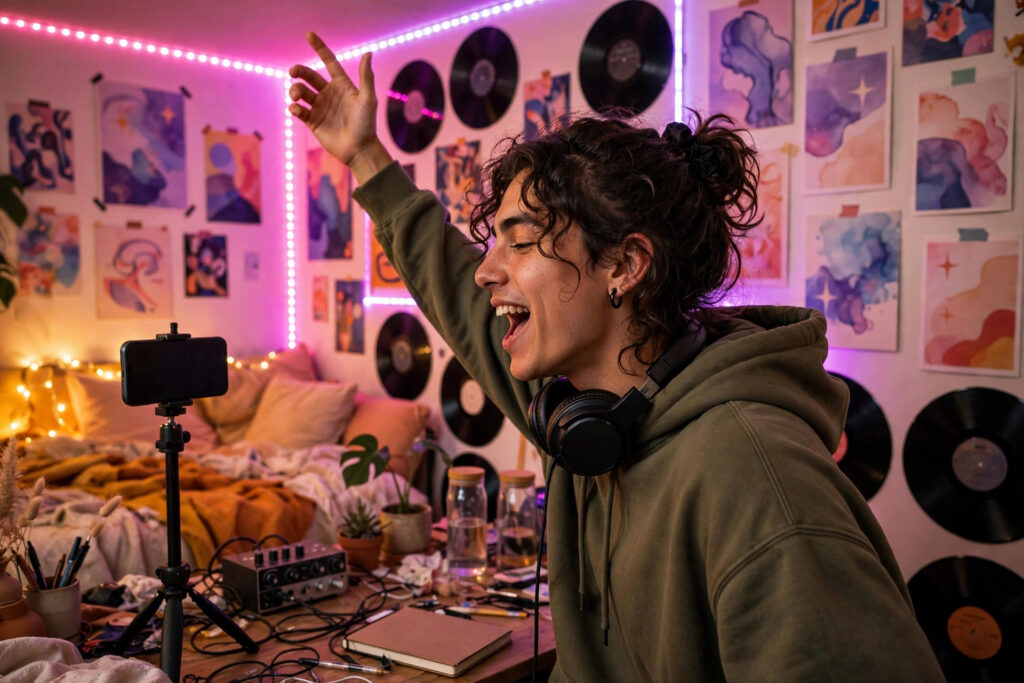
Fifteen seconds. That’s roughly what a pop song gets now to prove itself. Short-form video rewired pop songwriting from the inside out: hooks jumped to the opening seconds, choruses got built to loop and duet, and tracks started auditioning as clips long before they ever became full releases.
You’ve felt this even if you never opened a chart report. A song shows up in your feed as a stranger singing one line into a phone camera. Two weeks later that same line is everywhere — in shops, in car windows, in your own head at 2 a.m.
The clip came first. The song came second. And honestly? That order isn’t an accident anymore. It’s the blueprint.
The chorus moved to the front door
Old pop structure was patient. Verse, pre-chorus, chorus — a slow escalator ride, and the big payoff landed a minute or so in. Radio could afford that patience. A DJ had already committed to playing the track, and you were stuck in traffic anyway.
The feed doesn’t work like that. Your thumb is the DJ now, and it’s ruthless.
So songwriters flipped the architecture. The catchiest line — the one built for a 15-second hook — often opens the track or lands within the first half-minute. Intros shrank. Some disappeared entirely. Why bury the moment everyone’s going to clip?
The listening data backs up the pressure. According to IFPI’s Engaging with Music 2023 report, 82% of 16-to-24-year-olds engage with music through short-form video daily — the highest rate of any format for that age group. If your first audience meets the song as a swipeable clip, you write for the swipe.
Songs now audition before they exist
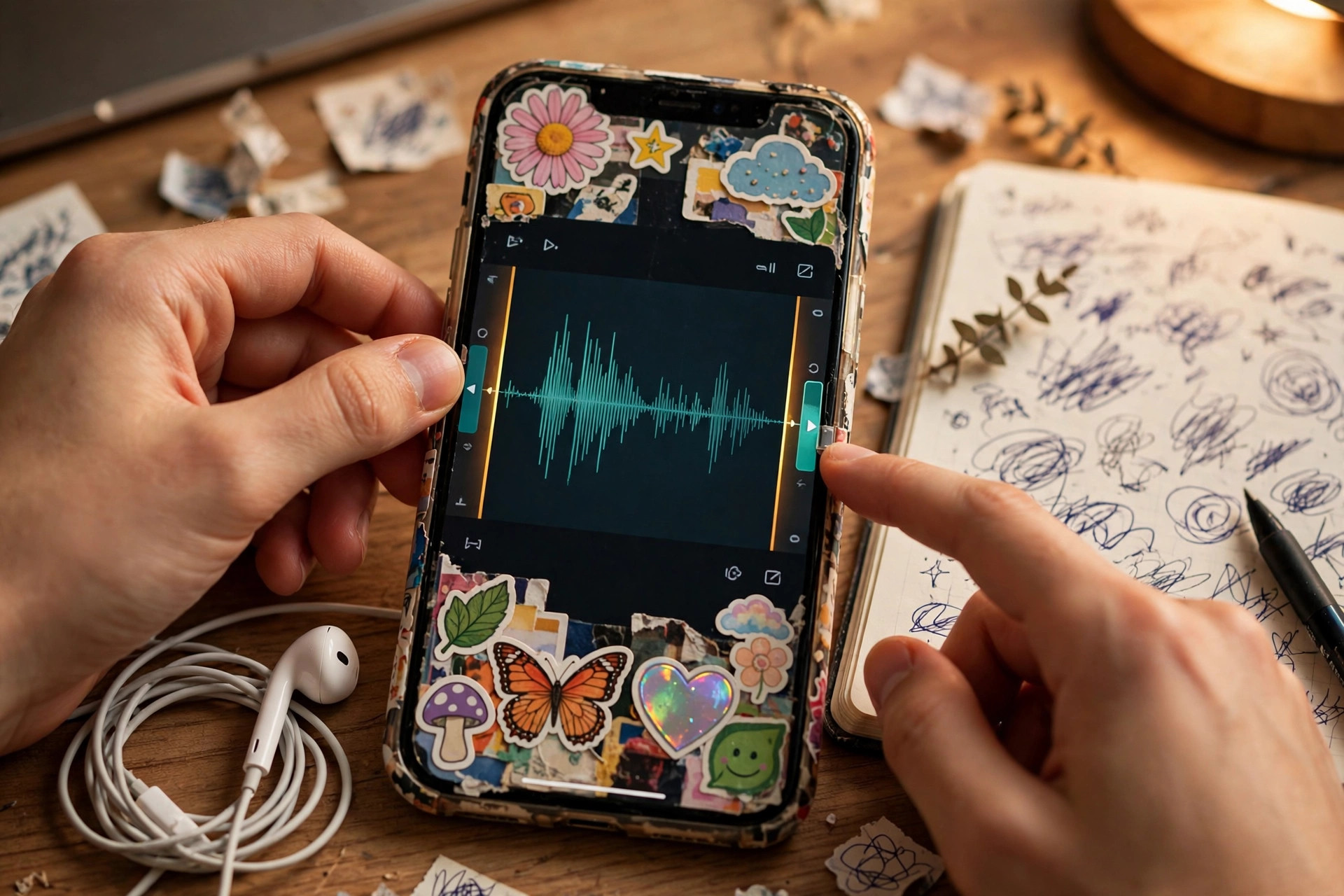
Here’s the stranger shift. Songs used to be finished, released, and then promoted. Now the promotion is the test run, and plenty of tracks never get finished until a clip tells the artist they’re worth finishing.
The pattern looks like this:
- An artist posts a rough chorus — bedroom recording, no mix, no master.
- Comments flood in demanding the full version.
- The finished song arrives weeks later, already famous in miniature.
Steve Lacy’s “Bad Habit” followed a version of this path, with clips circulating before the official release turned it into a chart-topper. Lil Nas X built “Old Town Road” the same way, feeding memes and clips until, according to Billboard, the song spent a record-breaking 19 weeks at number one on the Hot 100.
Think about what that does to writing. A hook isn’t just a melody anymore. It’s a pitch. It has to survive a comments section full of people who owe it nothing.
Shorter songs, denser songs
The runtime math is hard to argue with. Data reported by Quartz found the average Billboard Hot 100 song fell from 3 minutes 50 seconds in 2013 to about 3 minutes 30 seconds in 2018. Chartmetric’s 2024 Year in Music report, covered by Digital Music News, put the average Spotify-charting song at roughly 3 minutes — about 30 seconds shorter than in 2019.
Some tracks barely clear the runway. Lil Yachty’s “Poland” runs 83 seconds and still reached number 40 on the Billboard Hot 100, according to Digital Music News’ reporting on Chartmetric data. Eighty-three seconds. That’s not a song with a bridge missing — that’s the hook, twice, and out.
Streaming economics push the same direction. Spotify’s royalty rules count a stream once a track plays past 30 seconds, which quietly rewards songs that get to the point fast and invite a replay. A three-minute track you play twice beats a five-minute track you skip halfway. Songwriters can read a spreadsheet as well as anyone.
Shorter doesn’t automatically mean emptier, though. Plenty of new pop crams two hooks, a key change, and a fake-out ending into the space an older song used for its second verse. The density went up as the runtime came down.

The remix is now a second release
Then there’s the afterlife. A song drops, and if a sped-up edit starts moving on short-form feeds, an official sped-up version often follows — sometimes released by the artist’s own team. Slowed-and-reverbed edits do the same job at the opposite tempo, turning bangers into late-night mood pieces.
This isn’t piracy with better branding. It’s a release strategy. One composition, multiple tempos, each one aimed at a different corner of the feed:
- Sped-up versions — brighter, punchier, made for dance clips and quick cuts.
- Slowed versions — dreamier, built for edits, fan cams, and sad-girl hours.
- Acoustic or stripped versions — the same hook, re-dressed for a different playlist mood.
Catalog songs get resurrected this way too. A track from a decade ago trends because someone pitched it up 10%, and suddenly it’s charting next to this week’s releases. The song didn’t change. The frame around it did.
Built to loop, built to duet
Listen closely to a modern chorus and you’ll hear the engineering. The last bar often resolves in a way that flows straight back into the first — because on a looping video, the end is the beginning. If the seam is invisible, you watch three times without deciding to. Congrats, the song just tripled its exposure.
Duets and stitches shape the writing too. Open verses — a track released with a deliberate gap for another singer — turn listeners into collaborators. Call-and-response choruses give creators a part to play. A hook that leaves room for you isn’t being generous. It’s being smart.
Ask it this way: is the chorus a moment, or is it a template? Increasingly, it’s both. The melody lands the feeling, and the structure hands strangers the tools to remake it.
What gets lost — and what refuses to die
Not everyone’s thrilled. Critics argue the bridge is endangered, that slow-burn songs — the ones that take three minutes to break your heart — get filtered out by a system that judges in seconds. There’s truth in that. A feed can’t premiere patience.
But the counter-evidence keeps showing up. Taylor Swift’s “All Too Well (10 Minute Version)” hit number one on the Hot 100, according to Billboard, becoming the longest song ever to top that chart. Ten minutes. In the hook era. Long songs didn’t die; they just became a statement instead of the default.
And hooks themselves aren’t some TikTok invention. Motown writers fought to front-load choruses in the 1960s. Punk did it with two-minute songs decades before the algorithm. What’s new isn’t the hook. It’s the measurement — every skip, loop, and duet counted, fed back, and written into the next session.
The song is still the song
Strip away the strategy talk and something simple remains. A great 15 seconds usually points to a great song. The clips that survive the feed tend to be the ones with a melody people want to live inside for three full minutes — or ten.
Writers aren’t dumbing pop down. They’re writing for the door listeners actually walk through. The door just happens to be very, very fast.
Frequently asked questions
Why do so many pop songs put the chorus at the very start now?
Because most listeners first meet a song as a short clip in a feed, where skipping takes one thumb movement. Opening with the hook — or landing it within the first 30 seconds — gives the song its best moment before the swipe. Streaming rules reinforce it, since a play typically counts once a track passes the 30-second mark.
Are pop songs actually getting shorter?
Yes, on average. Data reported by Quartz showed the average Billboard Hot 100 song shrinking from 3 minutes 50 seconds in 2013 to about 3 minutes 30 seconds in 2018, and Chartmetric’s 2024 report put the average Spotify-charting song at roughly 3 minutes. Outliers still exist — long songs can and do top the charts.
Why do artists officially release sped-up versions of their own songs?
Because sped-up edits often take off on short-form video first. Releasing an official version lets the artist capture those streams, feed the trend instead of fighting it, and give one song several lives at different tempos and moods.
Did TikTok invent hook-first songwriting?
No. Motown, punk, and classic pop all front-loaded hooks long before social feeds existed. What short-form video changed is the feedback: skips, loops, and duets are now measured instantly, so writers hear exactly which seconds worked — and write the next song accordingly.
This article was created with AI assistance and reviewed by our editorial team before publishing.