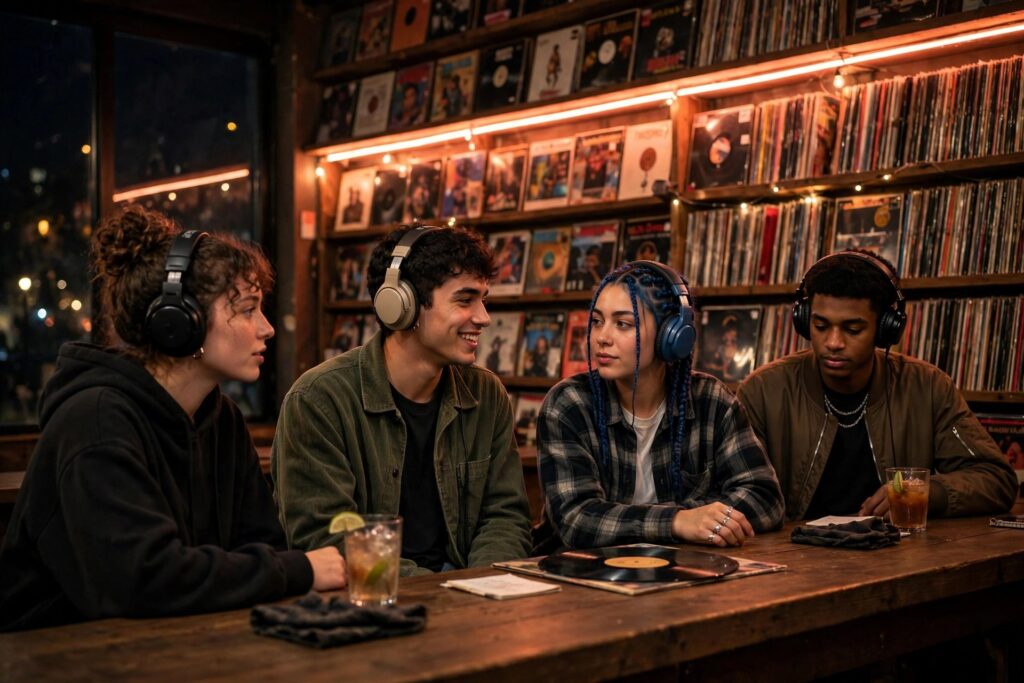
Vinyl listening bars give Gen Z something feeds can’t: a room built for doing one thing slowly, together. You pick a record, you sit down, you actually hear the whole side. No skipping. No posting mid-song. Just a shared hour that asks almost nothing from you except attention.
A room that runs on one simple rule
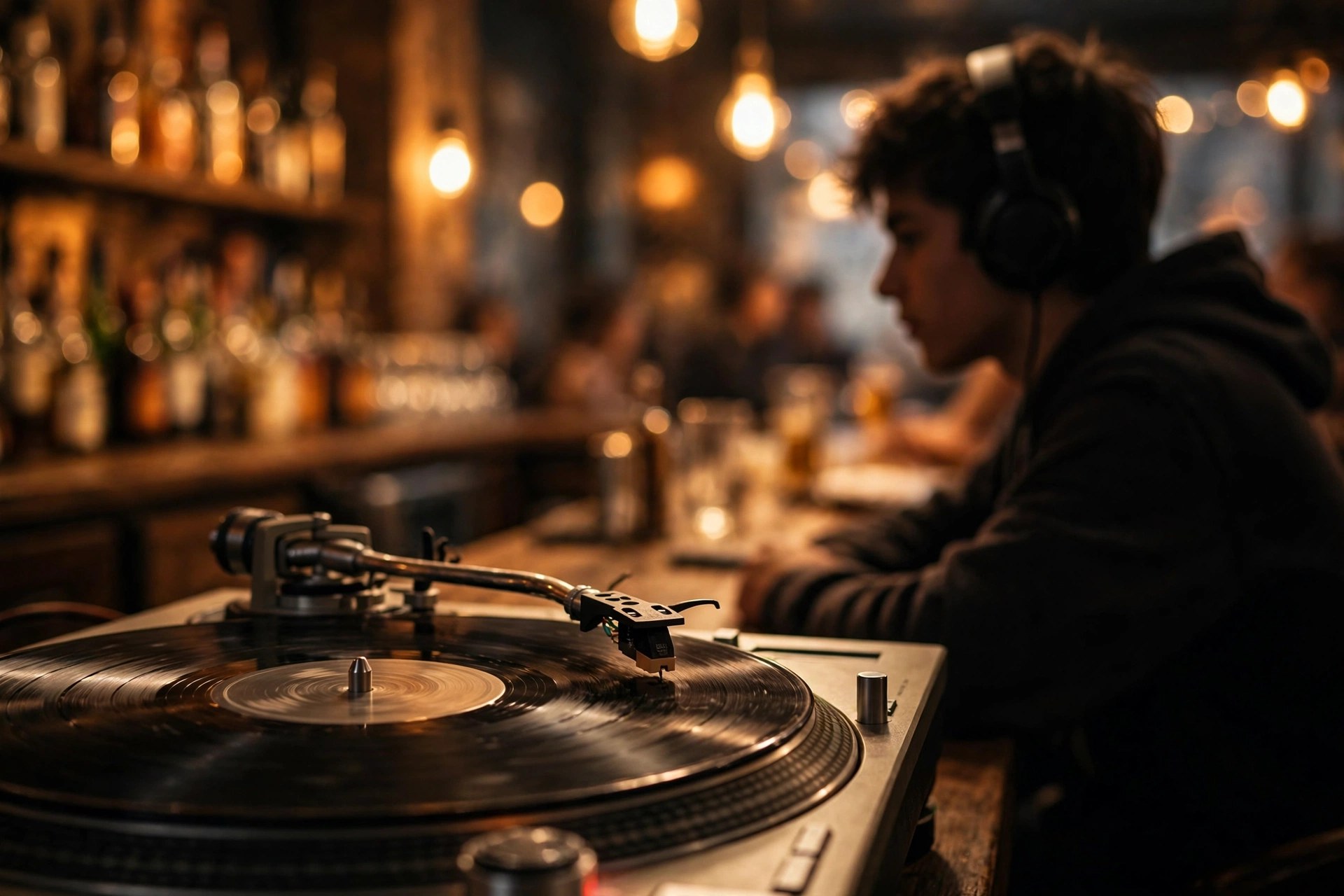
Walk into a listening bar and the setup hits you fast. There’s a counter. Behind it, shelves of records and a good turntable. Over your seat, a pair of headphones or a set of speakers tuned for the room.
Nobody’s performing. Nobody’s working the crowd either. The record is the event, and that flips the usual night out on its head.
Most bars compete for your attention. Music fights the TVs, the TVs fight your phone, your phone fights the person across from you. A listening bar removes the fight. One album plays, start to finish, and the room agrees to hear it.
That agreement sounds small. It isn’t. Shared rules are what turn a random group of strangers into a temporary community, and this rule takes about ten seconds to learn.
Where the format came from
The idea isn’t new, and that’s part of the appeal. Japan’s jazz kissa cafes have played records for attentive customers since the middle of the last century, according to histories of the format published by Japanese cultural archives and music journalists who have documented the scene for decades.
Those early rooms were built around scarcity. Imported records were expensive, home hi-fi gear was expensive, so a cafe with a serious collection became a public library for sound. You went there to hear things you couldn’t hear at home.
The modern version keeps the ritual and drops the scarcity. Streaming puts nearly every album ever made in your pocket. What it can’t give you is a room, a ritual, and other people who showed up for the same record.
So the new bars sell the one thing streaming left out. Presence. You can’t pause a room.

The third place idea, explained plainly
Sociologist Ray Oldenburg coined the term “third place” for the spots that are neither home nor work: cafes, barbershops, corner bars, the places where community actually happens. His work is still widely cited in urban studies courses and city planning research.
Third places share a few traits. They’re cheap to enter. Conversation is welcome but never forced. Regulars set the tone, and status from the outside world mostly stays at the door.
Listening bars fit that template almost perfectly. A cover charge or a single drink buys you the evening. You can talk between sides and go quiet during them. A student and a software engineer get the same seat, the same headphones, the same record.
For a generation that does school, work, and friendship through the same glowing rectangle, a physical third place hits differently. It has walls. It has hours. You have to actually go there, and going there is the whole point.
Why now, and why this generation
Timing matters here. Gen Z grew up fluent in streaming and tired of it at the same time. Playlists are infinite, and infinite gets exhausting. Every song arrives with a skip button and a quiet pressure to find a better one.
Vinyl reverses that pressure. A record side runs about twenty minutes, give or take, and you live with the sequencing the artist chose. Weak track in the middle? It plays. That constraint, weirdly, relaxes people. There’s nothing to optimize.
The Recording Industry Association of America has reported vinyl revenue growing for well over a decade, with vinyl outselling CDs in recent annual reports. Those figures get cited a lot, usually to talk about collecting. The listening bar story is different. It’s not really about owning records. It’s about hearing them somewhere that isn’t your bedroom.
Plenty of regulars own no turntable at all. They rent the ritual by the evening, the same way earlier generations rented bowling lanes and karaoke rooms.
Silence is the social contract
Here’s the part outsiders get wrong. The quiet in a listening bar isn’t snobbery. It’s load-bearing.
Talking over a quiet passage ruins it for the whole counter, so most rooms set clear norms. Chat freely while the staff flips the record. Keep voices low while it plays. Some rooms go further and run dedicated silent sessions for full albums.
That structure solves a real social problem. A lot of young people want to go out without performing sociability for three straight hours. Bars demand banter. Clubs demand energy. A listening bar lets you be around people at low volume, yours and theirs.
You can arrive alone and not feel alone. You can bring a friend and not run out of things to say, because the record fills the gaps. Awkward silence stops existing when silence is literally the program.
Psychologists who study loneliness often point to what they call parallel activity: being together while doing something side by side. Cooking classes work this way. So do climbing gyms and co-working spaces. Listening bars might be the purest version yet, since the shared activity asks for nothing but ears.
One evening, start to finish
So what does a night actually look like? It has a rhythm, and the rhythm rarely changes. That predictability is a feature, not a bug. Regulars plan around it the way earlier generations planned around a favorite TV broadcast.
- 6:30 p.m. — Doors and browsing. Early arrivals flip through the request crates and the new arrivals shelf. Staff take requests on paper slips, one per person, no guarantees.
- 7:00 p.m. — First side. Lights drop a notch. A staff pick opens the night, usually something warm and familiar to settle the room.
- 7:45 p.m. — The flip and the break. Talking comes back, drinks get refilled, and the request slips for the next side get read out loud.
- 8:00 p.m. — The feature album. One full record, both sides, minimal talking. This is the slot regulars book their evenings around.
- 9:30 p.m. — Open deck wind-down. Shorter picks, livelier records, conversation back up. People trade recommendations and argue, happily, about rankings.
- 10:30 p.m. — Last record. Almost always a closer with history in that room. Regulars know it. Newcomers get told about it on the way out.
Notice what’s missing from that timeline. No content creation window. No moment designed to be filmed. Some rooms even discourage phones at the counter, and regulars tend to enforce that norm more strictly than staff do.
The evening also ends at a sane hour. That’s quietly radical for nightlife. You can have a full night out and still make a morning lecture, a shift, or a train without wrecking the next day.
The economics, without the hype
Listening bars also make sense as small businesses, which helps explain why they keep opening. The model is lean. A small room, a serious sound system, a record collection that grows slowly, and drinks or coffee to cover the margins.
Owners interviewed in trade coverage of the hospitality industry tend to describe the same trade-off. Capacity stays low on purpose. Turnover stays low too, because nobody rushes a record. Revenue per seat has to come from people staying happily, not from churning tables.
That shapes the crowd in a healthy way. A room that needs you to stay two hours treats you differently from a room that needs your table in forty minutes. Staff learn names. Regulars get their requests played often enough to feel heard and rarely enough to keep it special.
There’s risk in the model, sure. Rent doesn’t care about your ritual. But the format travels well across cities because the core kit fits in a small footprint, and word of mouth does most of the marketing. A room people describe as “you have to feel it” is annoyingly hard to advertise and extremely easy to recommend.
Discovery works differently here
Algorithms are great at finding more of what you already like. They’re bad at handing you something you’d never pick and making you sit with it until it clicks.
A listening bar does exactly that. Someone else’s request becomes your next forty minutes. A genre you scroll past on your own gets a full, fair hearing on a proper system, in a room where giving up on it early isn’t an option.
Music educators have long argued that repeated, attentive listening changes how people hear structure and detail. You don’t need the academic version of that claim to feel it working. By the third track of an album you’d never choose, you start hearing what its fans hear. Sometimes you become one. Sometimes you don’t, and the argument afterward is half the fun.
Discovery also runs sideways, person to person. The stranger two seats down who requested the record knows three more like it. That recommendation carries context an algorithm can’t offer: a face, a reason, and a story about a live show in a basement somewhere.

Not a backlash, exactly
It’s tempting to frame all this as a revolt against phones. That framing is too neat, and regulars would probably laugh at it. The same people booking listening sessions post about them, group-chat about them, and find the rooms through social feeds in the first place.
What’s changing isn’t the technology. It’s the scheduling. Screens get the gaps in the day. The listening bar gets a protected block, the way a gym class or a film screening does. Attention becomes an appointment instead of a default setting.
That distinction matters for how long this lasts. Backlashes burn out. Habits stick. A weekly session with friends, a standing Friday slot, a first-date format that reliably works: those are habits, and habits are how third places survive.
There are limits, obviously. Rooms are small, cities are expensive, and hype can swamp a quiet format fast. A listening bar that becomes a backdrop first and a listening room second will lose the regulars who made it worth visiting. The format’s defense is built in, though. You can’t fake quiet. Either the room protects the record or it doesn’t, and everyone present knows within one side.
What to do on your first visit
Going for the first time? Keep it simple.
- Arrive near the start of a session, not mid-album. Settling in during a quiet passage feels bad for everyone.
- Bring one request, not five. Pick the record you’d play a friend to explain your taste in one shot.
- Sit at the counter if you can. The counter is where regulars talk between sides and where staff explain what’s playing.
- Let a full side play before judging the place. The first ten minutes can feel strange if you’re used to skipping. The calm lands slowly.
- Ask one person one question. What else sounds like this? is undefeated as an opener in a room built for exactly that question.
Skip the urge to document every minute. Take your one photo at the break if you want it, then put the phone away and let the second side do its work. You’ll remember the room better than your camera roll will.
And if the feature album isn’t your thing? Stay anyway. Some of the best nights in these rooms start with a record you’d never choose and end with you texting a friend the title from the sidewalk.
The staff are curators, not DJs
One role in the room deserves its own mention. The person behind the counter isn’t DJing, and the difference shapes the whole night.
A DJ reads a crowd and reacts minute by minute. A listening bar host commits to a sequence and defends it. They sequence a mellow opener against a stranger feature album, they know which pressings sound dull and which ones sing, and they keep notes on what regulars requested three weeks ago.
That curation builds trust over time. Regulars stop requesting for a while and just show up, the way you stop reading a favorite critic’s star ratings and start trusting the byline. When the host puts a record on without announcing it, the room leans in. That lean is earned, never bought.
It also creates a gentle kind of accountability. A bad pick gets discussed at the break, face to face, usually with humor. A great pick gets a small round of nods when the needle lifts. No metrics dashboard captures either reaction, and both matter more than a stream count.
Different cities, same quiet
The format looks a little different everywhere it lands, and those local twists keep it from feeling like a franchise. Seoul rooms lean into hushed, library-like focus. London spaces often pair listening sessions with natural wine and small plates. American rooms tend to be louder between sides and stricter during them.
College towns add their own flavor. Sessions double as study-adjacent hangouts early in the evening, then turn social after the feature album. Students who would never share a playlist will share a counter for two hours, which tells you something about how much context matters in taste.
What stays constant across all of it is scale. These rooms stay small on purpose, usually a few dozen seats at most. Smallness protects the sound, protects the norms, and protects the feeling regulars describe most often: for two hours, the outside world got quieter, and nobody had to leave the city to make that happen.
The bottom line
Vinyl listening bars aren’t really about vinyl. Records are just the most elegant excuse anyone has found lately for a room full of young people to sit down, be quiet together, and give one thing their full attention.
Home is private. Work and school are demanding. The feed is endless and somehow still lonely. A listening bar sits in the gap between all three: public but calm, social but undemanding, old in its bones and new in its crowd.
That’s what a third place has always been. The furniture changed. The need didn’t.
This article was created with AI assistance and reviewed by our editorial team before publishing.